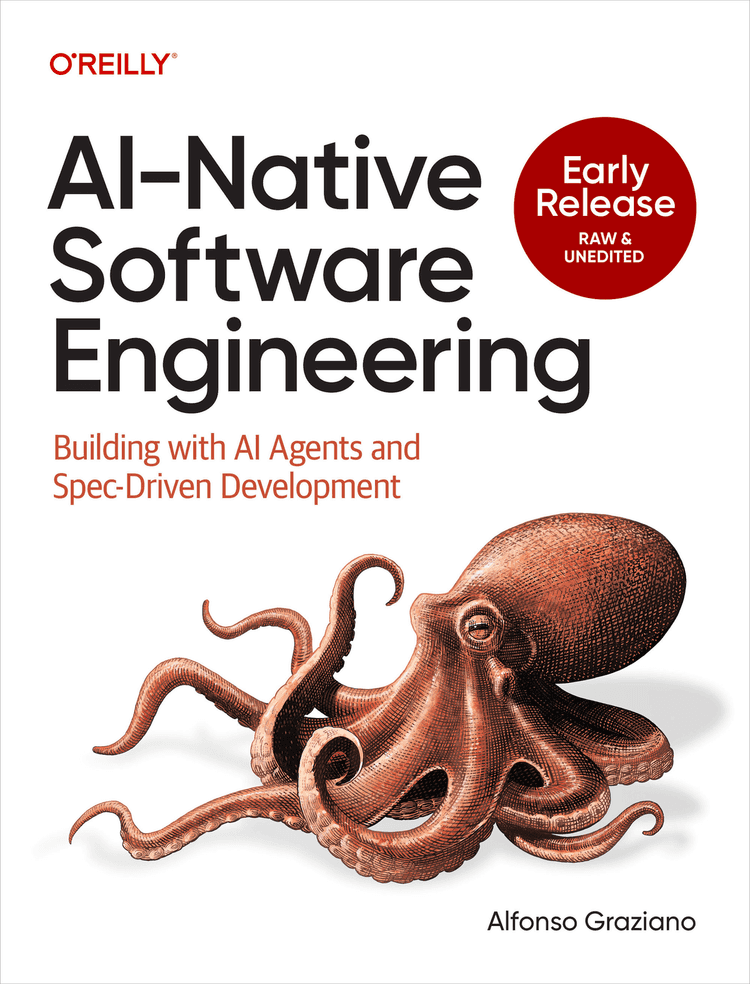
AI-NativeSoftware Engineering.
Building software with AI agents and spec-driven development.
The practical guide for professional software engineers who want to integrate AI across the entire development lifecycle, not as a tool, but as a core engineering capability. Structured, production-oriented, tool-agnostic.
The Early Release is available now, more on the way.
Delivered by Substack. No spam, one click to leave.
“The difference between engineers who thrive in the AI era and those who struggle isn't talent or experience. It's having a structured approach.”
What this book covers.
Context Engineering
Assemble the right context (code, docs, rules, examples) so AI tools produce consistent, high-quality outputs every time, not just occasionally.
Spec-Driven Development
Use specifications as durable artifacts that guide AI, keep implementations aligned with intent, and survive every tool change or model upgrade.
Harness Engineering
Build the environment around the agent, the rules, skills, tests, and feedback loops that let it do reliable work and correct itself when it drifts. Agent equals model plus harness.
Agent Orchestration
Know when to use single agents versus multi-agent systems, apply proven orchestration patterns, and prevent hallucination propagation across pipelines.
What you'll walk away with.
The full arc.
The AI-Native Engineer
The shift from implementer to orchestrator, the vibe-coding trap, and what makes an engineer irreplaceable.
From LLMs to Agents
How LLMs work from an engineer's-eye view, why they are good at code, and how tools, context, and a loop turn a model into an agent.
Context Engineering Fundamentals
Moving from prompt engineering to assembling the right context at the right time, so AI tools produce consistent outputs, not lucky ones.
Model Context Protocol
What MCP is and why it matters, its client/server/transport architecture, and how to operate MCP servers safely.
Spec-Driven Development
Why specs are the durable artifact that keeps AI-generated code aligned with intent, and how you already write them without realising it.
The SDD Workflow
The canonical loop — Specify, Plan, Execute, Verify, Integrate, Learn — and exactly where humans must stay in it.
SDD Frameworks Compared
Why frameworks exist and how to choose between them — or when no framework is the right answer.
Verification and Quality Gates
Where the bottleneck moves once coding is cheap, and the four layers that let AI-generated code meet the same bar as human-written code.
Agent Orchestration Patterns
Scaling one agent with compaction and scratchpads, then coordinating many agents while avoiding cascading failures.
Scaling AI-Native Engineering in Teams
Why buying licences changes nothing, what actually shifts when a team goes AI-native, and how to scale without burning out your best people.
AI-Native in Practice at Cogwheel
Nine weeks at Cogwheel: one team applies every practice in the book to ship the bet the company was too slow to ship.
Become an AI-Native Engineer in a week
7 days, 40 topics, theory and practice for each one, with curated videos and articles all the way through. The fastest route from using AI to engineering with it. No email needed.
The AI-Native Engineering Canvas
A one-page template your team runs as a workshop to design its own AI-native operating model: eight areas from framing and roles to verification and scaling. Free, printable, and drawn from the book.
How AI-native is your team?
29 questions drawn straight from these chapters, about what your team actually does. You get a number, a radar, three things to fix first, and a list of every question nobody could answer. About 10 minutes, and there is no email to hand over.
Want to learn more?
If you enjoyed the learning path, you'll love the newsletter. Subscribe and you'll be the first to know when the book is out, plus get early access to chapters as they are written.
Delivered by Substack. No spam, one click to leave.
Meet the author

Alfonso Graziano is a AI Lead at Nearform , where he builds AI agents and uses edge AI tools in production.
He built an MCP server for Node.js with over 100,000 downloads on Docker Hub, and has delivered 20+ conference talks across Europe.
Questions, answered.
What will I learn from this book?
You will learn how to build production software with AI systems using the core pillars of AI-Native Engineering: avoiding the vibe-coding trap, context engineering, spec-driven development, MCP tooling, and verification gates. Each chapter includes concrete patterns, real code, and team playbooks.
Who is this book for?
Software engineers, tech leads, and engineering managers who already use AI coding assistants but want to move past ad-hoc usage into repeatable, production-grade practices.
Do I need prior AI or ML experience?
No. The book assumes solid software engineering fundamentals but treats AI-Native Engineering as a discipline of software delivery, not as an ML research topic.
Which AI tools does the book cover?
The focus is on patterns that outlive any single tool, so what you learn applies to every environment and assistant you work in.
How is AI-Native Engineering different from vibe coding?
Vibe coding is ad-hoc AI usage that produces plausible code which fails in production. AI-Native Engineering is the disciplined alternative: explicit context, clear specs, verification gates, and team practices that ship reliable software.
Written like a software project.
A walkthrough of how this book actually gets built: the manuscript in version control, specs and rules for the chapters, agents doing real work inside the loop, and the checks that run before anything ships. The practices in these chapters are the practices behind them.