Skip to content
The book / reader reviews

What readers sayabout the book.
Rasul Rzayev on LinkedIn: "I recently had the chance to read your O'Reilly book and honestly it's one of the best books I've read in recent months. I really appreciated the topics, clear explanations and level of details. Thank you for writing such a great book!"
Zilal Eiz Al Din on LinkedIn: "I really liked your book! I bought other books and your book is still the best overall. Your answer to this question 'What do I need to be good at to stay valuable as AI gets better?' is really beneficial to me."
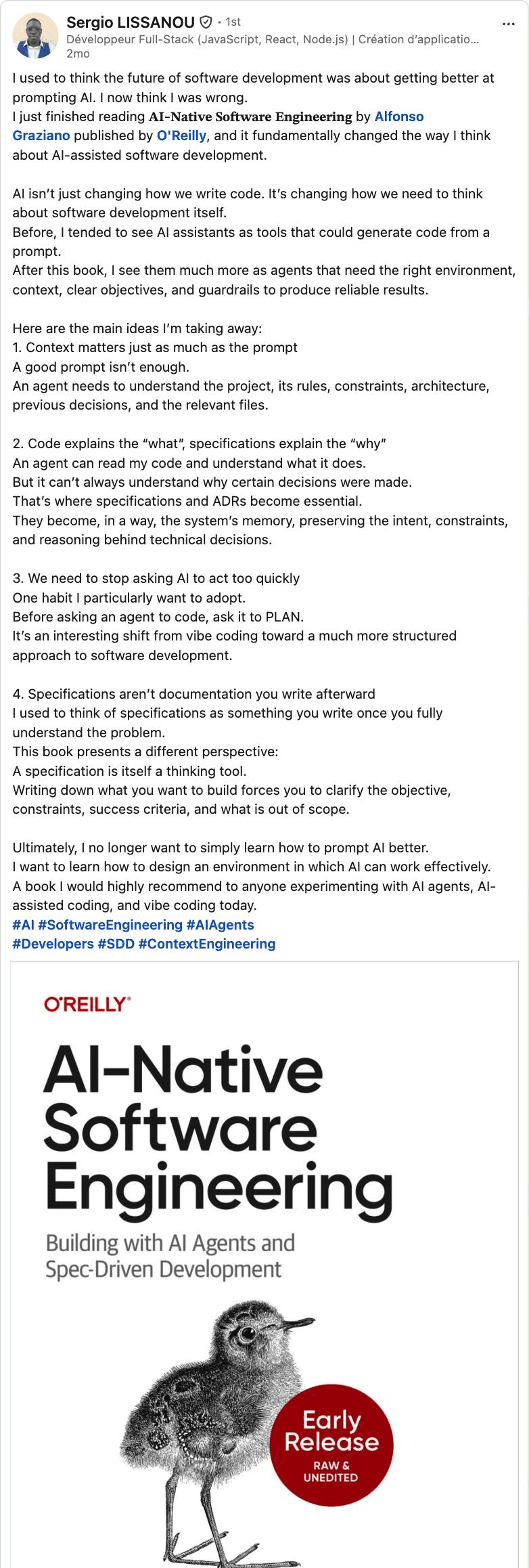
Sergio Lissanou on LinkedIn: "I used to think the future of software development was about getting better at prompting AI. I now think I was wrong.
I just finished reading AI-Native Software Engineering by Alfonso Graziano published by O'Reilly, and it fundamentally changed the way I think about AI-assisted software development.

AI isn't just changing how we write code. It's changing how we need to think about software development itself.
Before, I tended to see AI assistants as tools that could generate code from a prompt.
After this book, I see them much more as agents that need the right environment, context, clear objectives, and guardrails to produce reliable results.

Here are the main ideas I'm taking away:
1. Context matters just as much as the prompt
A good prompt isn't enough.
An agent needs to understand the project, its rules, constraints, architecture, previous decisions, and the relevant files.

2. Code explains the "what", specifications explain the "why"
An agent can read my code and understand what it does.
But it can't always understand why certain decisions were made.
That's where specifications and ADRs become essential.
They become, in a way, the system's memory, preserving the intent, constraints, and reasoning behind technical decisions.

3. We need to stop asking AI to act too quickly
One habit I particularly want to adopt.
Before asking an agent to code, ask it to PLAN.
It's an interesting shift from vibe coding toward a much more structured approach to software development.

4. Specifications aren't documentation you write afterward
I used to think of specifications as something you write once you fully understand the problem.
This book presents a different perspective:
A specification is itself a thinking tool.
Writing down what you want to build forces you to clarify the objective, constraints, success criteria, and what is out of scope.

Ultimately, I no longer want to simply learn how to prompt AI better.
I want to learn how to design an environment in which AI can work effectively.
A book I would highly recommend to anyone experimenting with AI agents, AI-assisted coding, and vibe coding today."
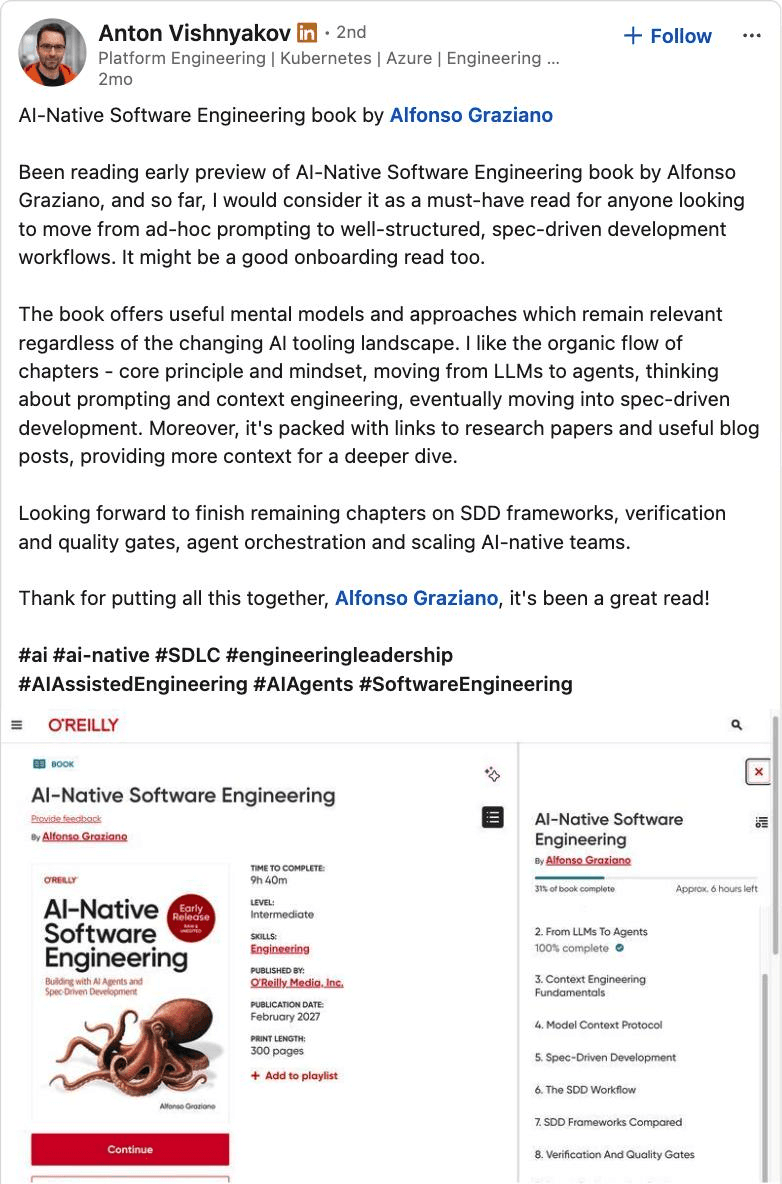
Anton Vishnyakov on LinkedIn: "Been reading early preview of AI-Native Software Engineering book by Alfonso Graziano, and so far, I would consider it as a must-have read for anyone looking to move from ad-hoc prompting to well-structured, spec-driven development workflows. It might be a good onboarding read too.

The book offers useful mental models and approaches which remain relevant regardless of the changing AI tooling landscape. I like the organic flow of chapters - core principle and mindset, moving from LLMs to agents, thinking about prompting and context engineering, eventually moving into spec-driven development. Moreover, it's packed with links to research papers and useful blog posts, providing more context for a deeper dive.

Looking forward to finish remaining chapters on SDD frameworks, verification and quality gates, agent orchestration and scaling AI-native teams.

Thank for putting all this together, Alfonso Graziano, it's been a great read!"
Out in the world

Where the book has turned up.
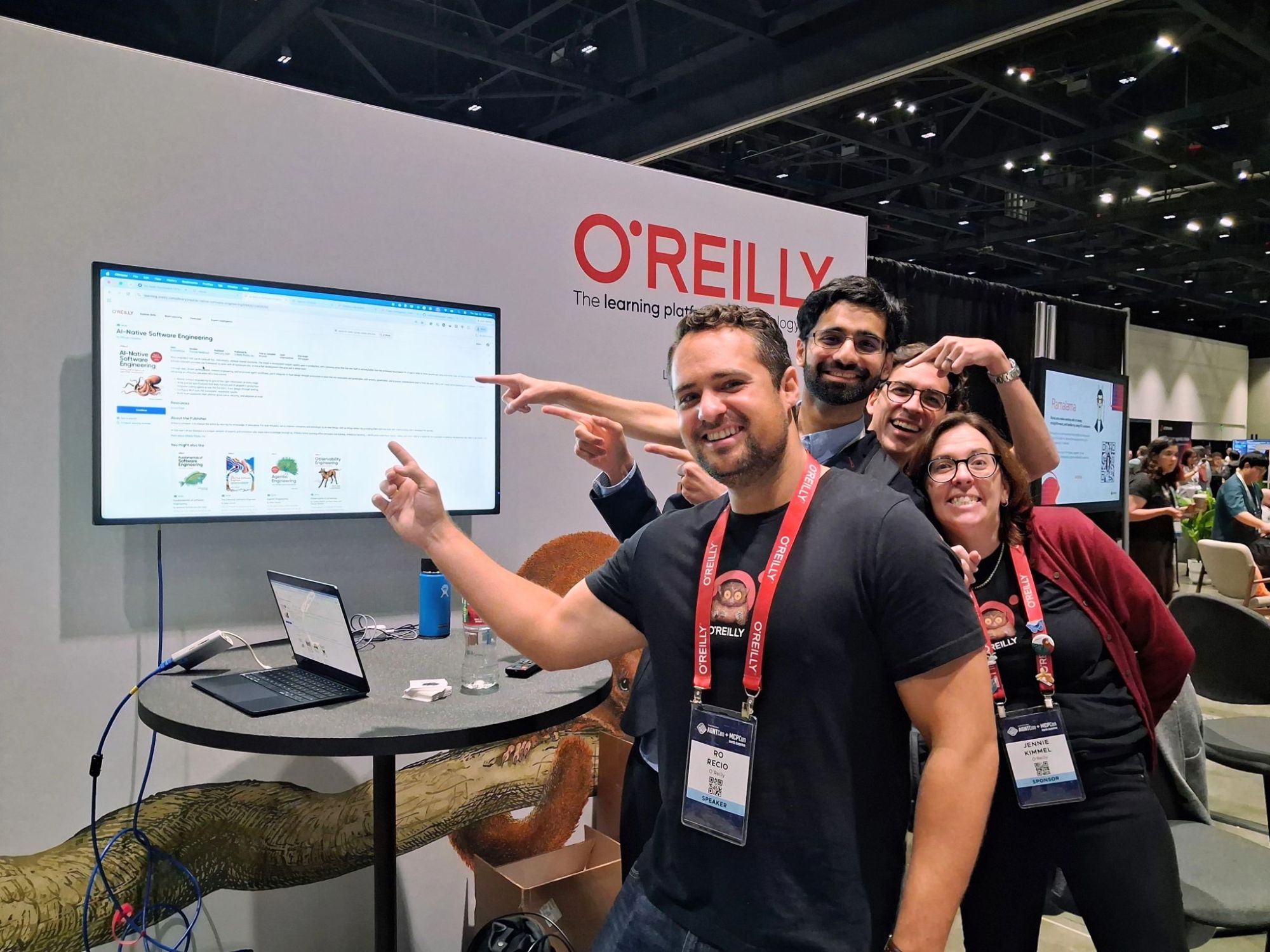
Four people at the O'Reilly booth smiling and pointing at a large screen that shows the AI-Native Software Engineering page on the O'Reilly learning platform
At the O'Reilly boothAgentCon + MCPCon North America

Not read it yet

Read the book →

What it covers, who it is for, and where to read it.

Read it already

Tell me what you think ↗

Post about it and tag me on LinkedIn. Good or bad, I read every one.