Skip to content
Free learning path · 7 days · 40 topics

Become an AI-Native Engineer in a week.

In one week you can learn more than many engineers who haven’t upskilled. This path is your starting point. Work through the theory and practice exercises to learn the mindset and apply it from day one.

01 / How to work through it
01

One day, one area

Each day covers one macro area, broken into topics. Every topic is its own page: the theory first, then a practice exercise you run on your own machine.

02

The links are the course

Every topic points at curated videos and articles. They are not extra reading. They carry most of the teaching, and the text around them is the map.

03

Two to three hours a day

That is the honest cost. You can stretch it over two weeks and lose nothing, but do not skip the practice half. Reading about agents does not make you fast with them.

04

Work in a real repo

Use a project you already know, not a toy. The whole point is to feel where the practices help and where they get in the way on code that has history.

02 / The seven days

Every topic has its own page with the theory, the practice exercise and the curated videos and articles it is built around. Open a day to see its topics, or jump straight to one.

Day 4

Context Engineering and MCP

You'll learn how to give AI the right context at the right time via rules, skills, and MCP. Strong context engineering is what makes AI outputs consistent and production-ready.

8 topics·30 min
  1. 01From Prompt Engineering to Context EngineeringWhy the craft has shifted from writing clever individual prompts to curating the full state an agent receives: tools, history, files, rules, and constraints. How that shift changes what good engineering looks like.
  2. 02Rules and Instructions: Persistent Context for Your AgentHow to use rules files, repository instructions, and AGENTS.md to give agents consistent, project-level context without repeating yourself in every prompt. The difference between global rules, project rules, and task-specific instructions.
  3. 03Skills and Commands: Reusable PatternsHow to package reusable capabilities as skills and reusable prompt workflows as commands, so agents can load exactly what they need for a task without bloating the default context.
  4. 04Custom Agents and PersonasWhen and how to define specialized agents configured for a specific role or task. How persona definitions, scoped instructions, and the AGENTS.md pattern let you build agents that stay focused and don't overstep.
  5. 05Rules, Skills, Commands, and Custom Agents: Knowing What to Use WhenA clear map of the four context management techniques available in modern AI coding tools, what each one is for, who triggers it, and how to combine them without creating a mess.
  6. 06Model Context Protocol (MCP): What It Is and Why It MattersWhat MCP is, why it emerged as a standard, and how the client-server architecture connects AI assistants to external data sources, tools, and APIs in a consistent and composable way.
  7. 07MCP Security: What Can Go WrongThe real security risks that come with connecting agents to external systems via MCP: prompt injection through tool outputs, data exfiltration, confused deputy attacks, and the practices that mitigate them.
  8. 08Harness Engineering: Everything Around the ModelWhy the systems wrapped around an LLM — the prompts, tools, sensors, and guardrails — matter as much as the model itself, and how to think about them as a discipline rather than a bag of tricks.
Day 7

AI in the SDLC

You'll see how AI-Native practices apply across the full lifecycle: from requirements and architecture through implementation, testing, review, and maintenance. This ties the week together and shows where to apply what you've learned.

7 topics·13 min
  1. 01AI in Requirements and Product CollaborationHow engineers can use AI to help gather requirements, turn them into structured user stories, and validate acceptance criteria before a single line of code is written. The SDLC starts before implementation, and AI can make the engineering-to-product handoff much more structured and less lossy.
  2. 02AI as the Bridge Between Design and DevelopmentHow AI is closing the gap between what designers create and what engineers implement. Tools like Figma MCP, v0, and Builder.io Visual Copilot let engineers turn design files, screenshots, or prompts into production-ready component code, reducing the manual translation work that traditionally consumed hours every week.
  3. 03Testing with AIHow to use AI agents to write, run, and maintain tests, from unit tests to end-to-end browser flows. Covers AI-generated test cases, Playwright MCP for browser automation, and the BMAD TEA module for risk-based test strategy and release gates.
  4. 04AI for DocumentationUsing AI to generate and maintain documentation: code comments, API references, architecture docs, and user-facing guides. Documentation rot is one of the most persistent problems in software teams; AI tools are starting to solve it by coupling docs directly to code and updating them automatically.
  5. 05Continuous AI: AI in Your CI/CD PipelineHow AI fits into CI/CD pipelines beyond running tests. GitHub Agentic Workflows, using AI models inside GitHub Actions to auto-triage build failures, fix broken tests, synchronize docs with code changes, and handle repetitive repo tasks that previously required manual effort.
  6. 06AI for Debugging and Incident ResponseUsing AI to speed up root cause analysis, correlate logs with code changes, and investigate production incidents. Engineers spend a significant chunk of their time debugging; AI tools are already cutting that time by a meaningful amount in real production systems.
  7. 07AI for Your Custom Workflows in the SDLCFrom automating performance audits on a frontend codebase to generating security reports, triaging support tickets or keeping runbooks up to date, almost every task you do in the SDLC can benefit from AI in some way. The key is knowing how to identify those opportunities and structure your workflow to take advantage of them.

40 topics, about 20,000 words of theory and practice, free to read and nothing to sign up for.

After day 7

See where your team actually stands.

The path teaches you the practices. The assessment scores how many of them your team really has: 25 questions, a radar, and three things to fix first. Around six minutes, no email.

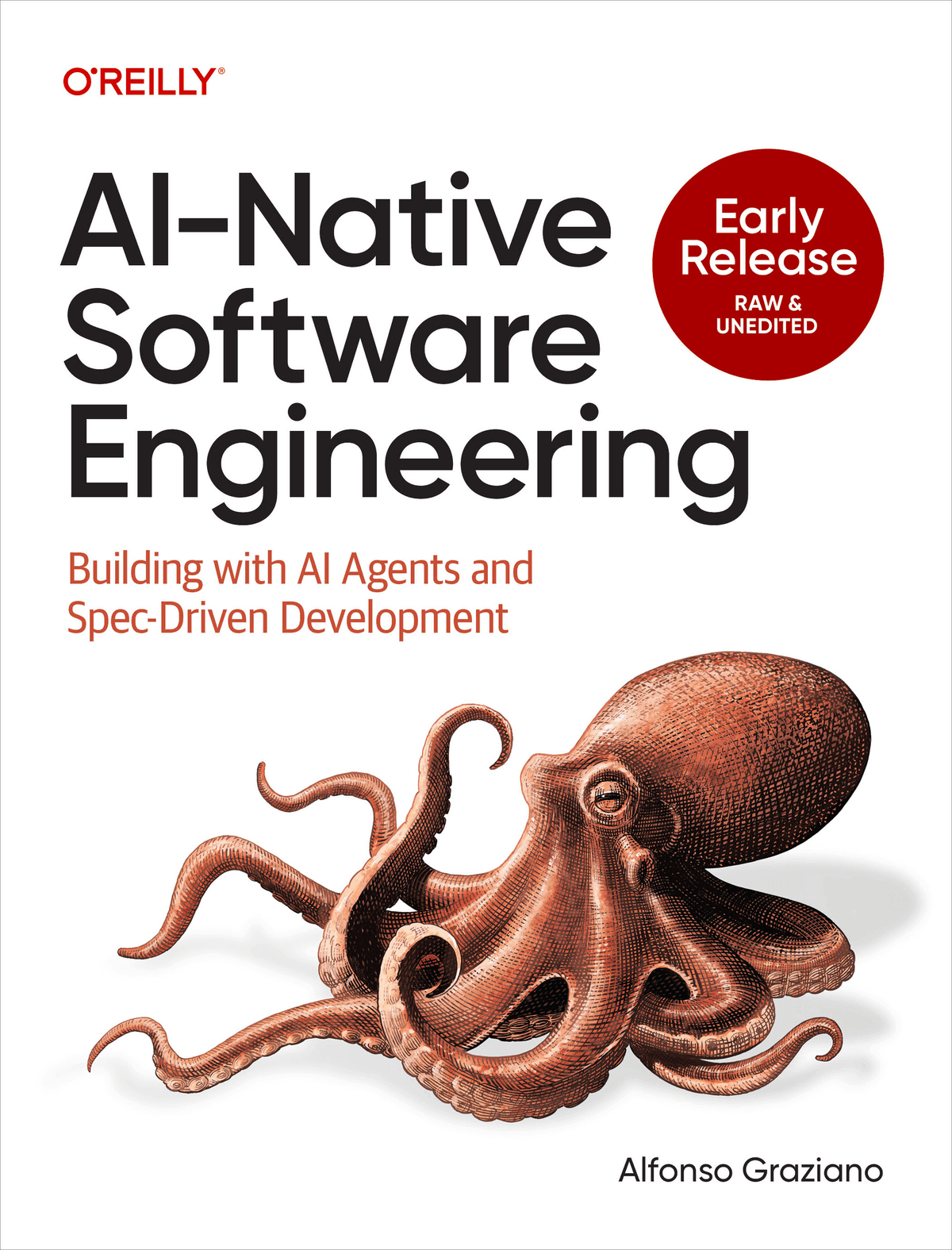
AI-Native Software Engineering — book cover
Want to go deeper

A week gets you started.The book gets you to production.

This path is the shortest route to the ideas. The book is where each one is worked out in full, with the patterns, the trade-offs, the failure modes, and what changes once a whole team works this way.

  • Context engineering
  • Spec-driven development
  • Agent orchestration
  • Verification & quality gates
  • Scaling AI in teams