The feedback story
The manager's request
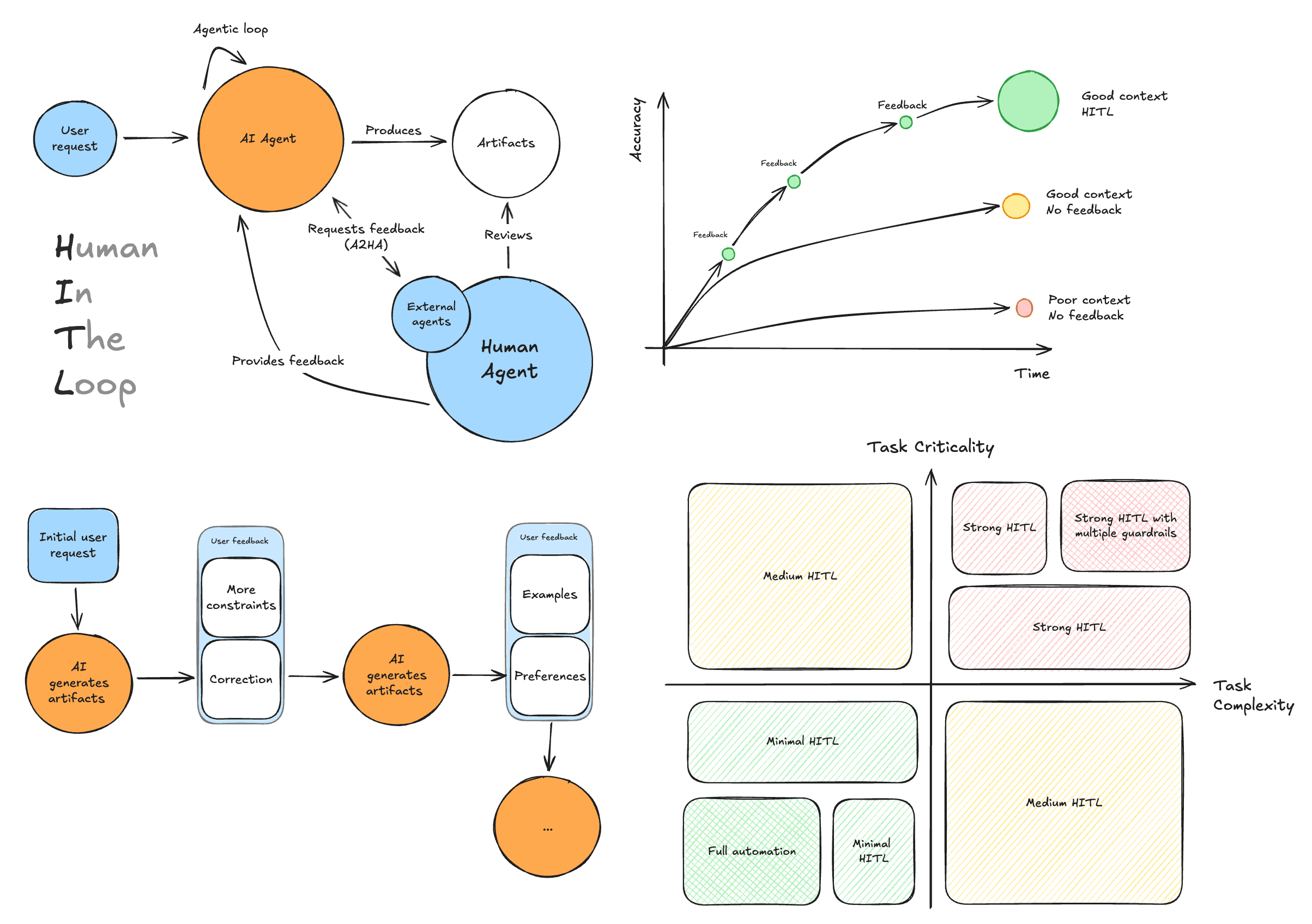
Your manager rushes to your desk with a vague request: 'We need a customer presentation… something about the quarterly results of our platform, value, impact… I'm super busy, so just make it good.' Then he disappears into another meeting.
You try your best. You spend five days polishing slides, adding diagrams, rewriting the story. You even add a few animations for extra flavour. But when your manager finally reviews it, his reaction is… painful.
The iterative approach
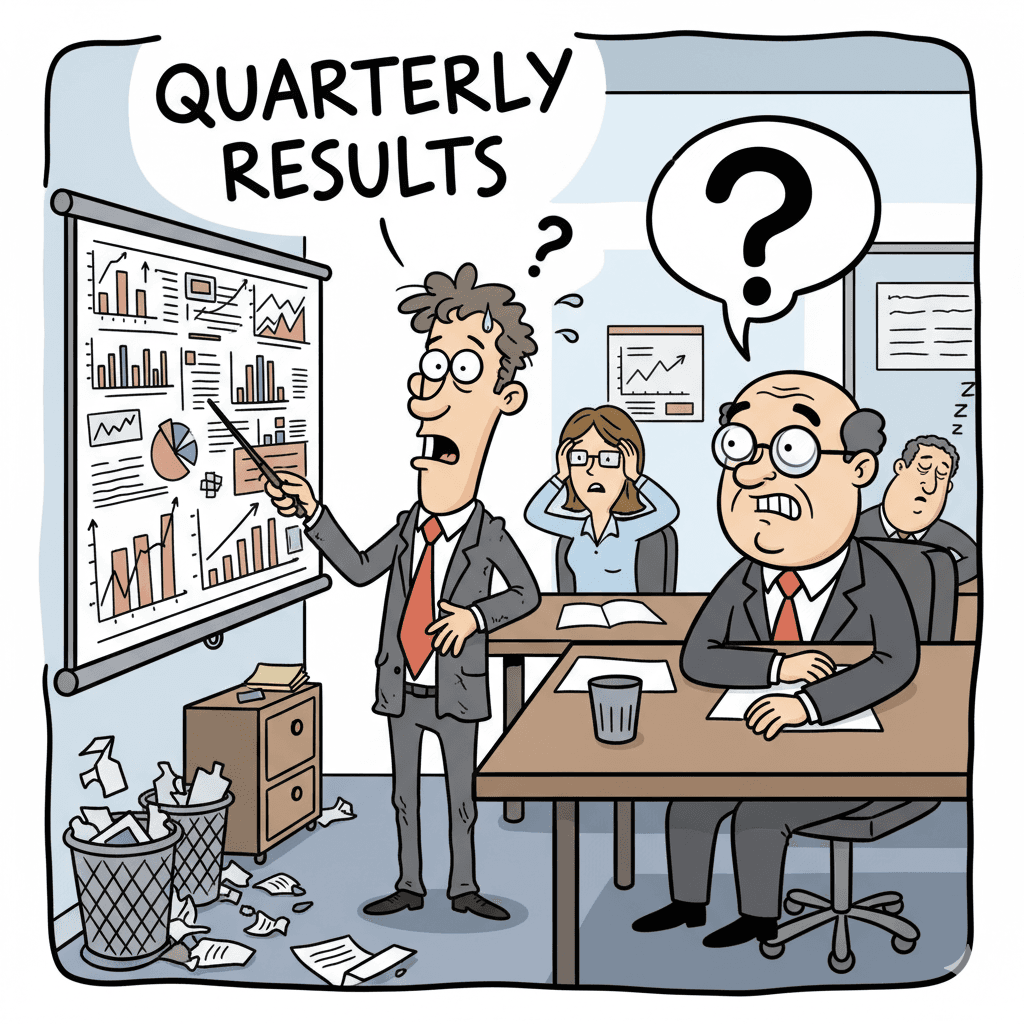
Same short request. But instead of working for five days in silence, you spend 20 minutes preparing a list of bullet points — the agenda, the key messages, the story flow — and send it over.
He replies quickly: "Good start. Remove part 3, focus more on value, and include a customer case study." You adjust, send it again, get another round of feedback and keep iterating.

After just one day, the full presentation is done and it is exactly what he needs for the customer.
This story is the perfect metaphor for how feedback transforms AI performance.
Feedback is the steering wheel
Without feedback, an AI system behaves like the first version of you: it tries its best, but if the initial instructions are vague or incomplete it may end up very far from your expectations. The model cannot read your mind — it only sees what you type.
With feedback, AI becomes more like the second version: fast, aligned and efficient. Each correction enriches its context. Instead of one long, risky attempt, you get many tight, controlled iterations that guide the system toward your real goal.
From automation to collaboration
The first wave of AI adoption advertised something different: automate complex tasks with a single prompt. 'Do everything end to end.' It looked magical in demos, but in real workflows it quickly showed its limits.
This was especially true on models that were not state of the art, or on SLMs (small language models). The output was inconsistent, missing details or simply wrong.
That is why the industry shifted from pure automation to collaboration. Instead of expecting the model to succeed alone, we place humans inside the loop: guiding, correcting and steering the AI step by step.
HITL enriches context in real time
Human-in-the-loop is not simply telling the AI it made a mistake. It is a structured way to enrich the AI's context in real time.
LLMs behave differently depending on the context they receive, as you may know from the context engineering pillar. If the context is incomplete, the model fills the gaps with assumptions. If the context is rich and continuously refined, the model becomes far more precise.
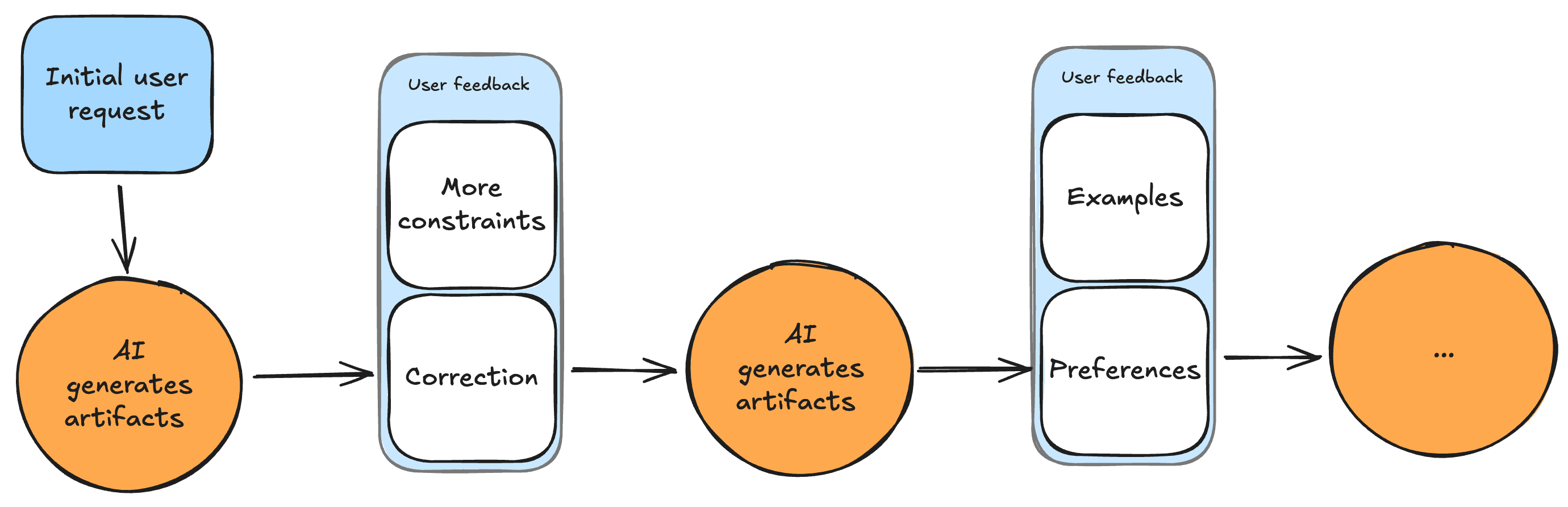
In other words, HITL turns every interaction into an opportunity to inject more meaning into the system. You are not just fixing mistakes: you are expanding the model's understanding of your world.
This enriched context becomes the fuel that drives better reasoning, fewer hallucinations and more stable results. The magic of HITL is simple: the AI becomes smarter not because the model changes, but because the context becomes richer.
HITL in agentic systems
Agents act, and actions have consequences
Agentic systems are not chatbots that answer questions. They run tools, read files, write code, modify documents and search the web. That makes them powerful — and it means actions create consequences, and consequences need supervision.
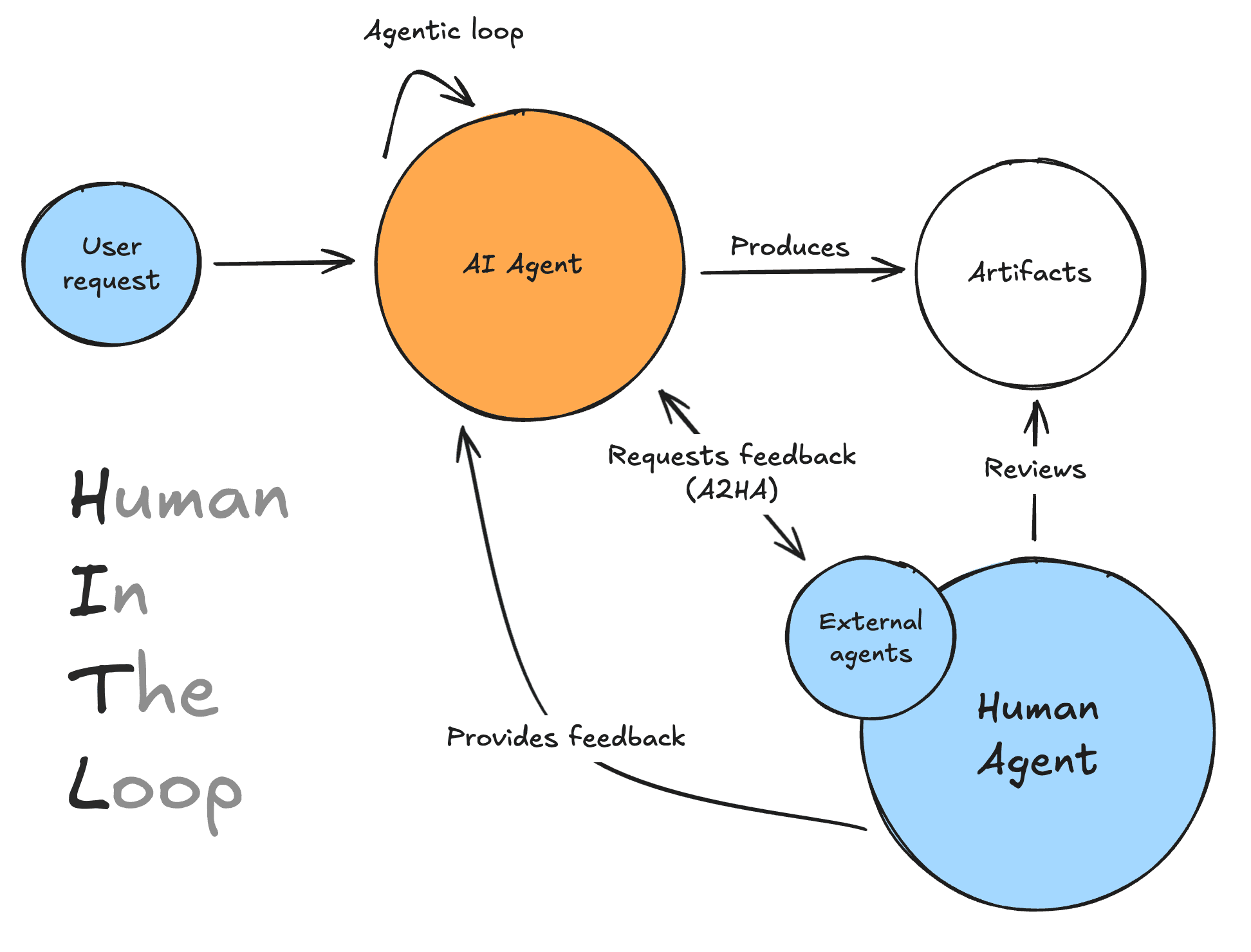
At the core of every agent lies a simple loop:
- Perceive the current state
- Decide what to do next
- Act by using tools or generating output
- Evaluate the results
- Repeat
If this reminds you of how a junior engineer works, that is not a coincidence. The agent tries something, observes what happened and then decides the next move. But without a human reviewing these steps, the agent might take a path that is technically correct but completely misaligned with your real goal.
HITL inserts you directly into this cycle, giving you the ability to guide, interrupt, refine or redirect the agent before small mistakes become big ones.
Artifacts: the footprints of AI actions
Every time an agent completes one iteration of the loop it produces artifacts. They are the real footprints of what the agent did.
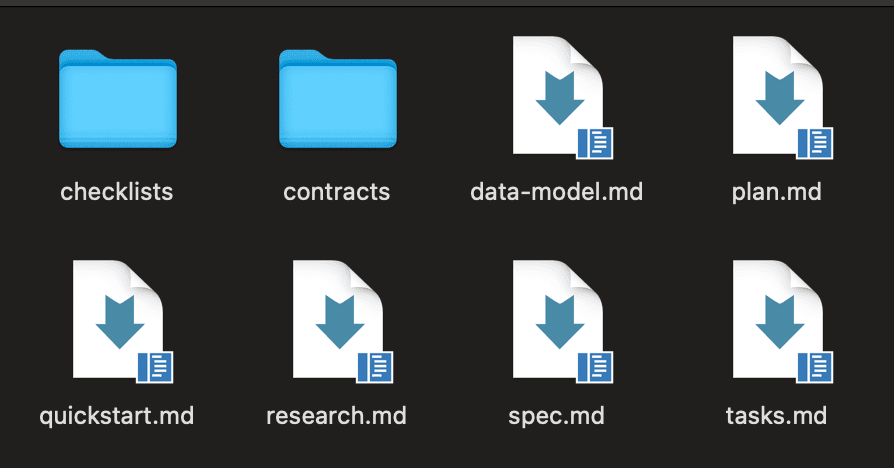
They can be:
Text
Files
Code
Edits
Logs
These artifacts are gold. They tell you what the agent understood, what it built and how it interpreted your request. An example of a process that generates multiple artifacts is spec-driven development, where the system produces specs and other text artifacts before implementing real code.
But artifacts also tell you something more important: where to intervene.
If a plan is wrong
No code should be written.
If the code is right but tests fail
The issue is likely in the behaviour.
Artifacts show you where feedback is needed and how to steer the next loop.
The review phase
Once the agent generates artifacts, it is your turn. This is where HITL proves its value.
You check the output and ask questions like:
- Does this match my intent?
- Are any steps missing?
- Did the agent misunderstand a constraint?
- Is the code correct? Efficient? Secure?
- Are the tests meaningful and complete?
Think of it like reviewing a pull request from a high-speed junior developer who never sleeps. You are not fixing everything yourself; you are deciding whether the next loop continues or adjusts course.
This human review prevents the agent from drifting and keeps the quality consistently high. It does not scale on its own, though: five reviews a day is a workload, twenty-five is a rubber stamp. Everything a machine can check should already have been checked before the artifact reaches you, which is what verification and quality gates is for.
The power of iteration
With each loop the agent refines its understanding, the context becomes richer, the artifacts become more accurate, and the distance between the current state and the desired state shrinks.
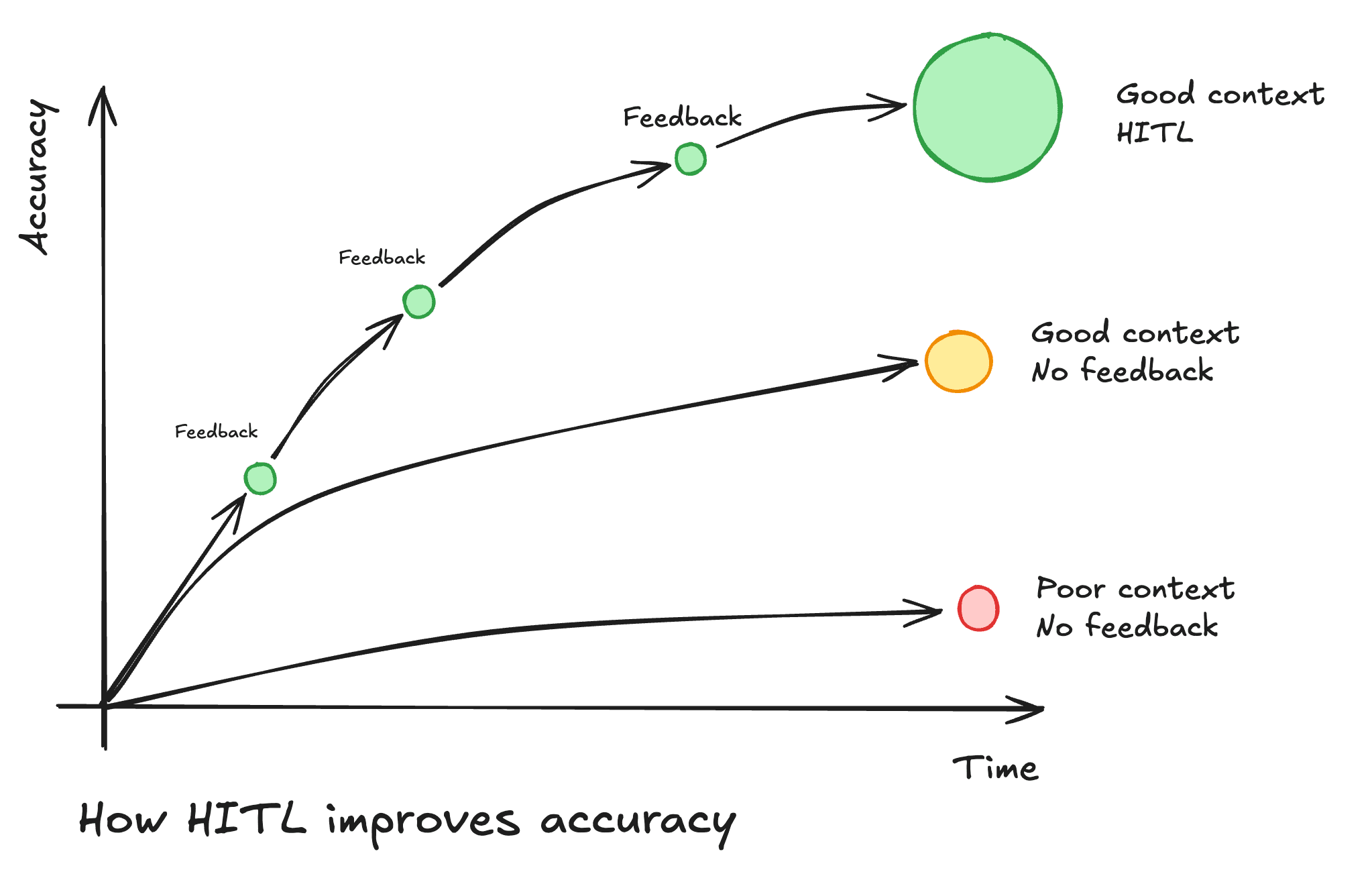
Because each round includes your feedback, the agent moves in the right direction faster and with fewer mistakes. Instead of a single high-risk attempt, you get multiple low-risk iterations.
This iterative alignment is what makes complex AI-driven development possible. You and the agent move forward together, step by step, until the final result is not just acceptable, but exactly what you envisioned.
That is the promise of HITL inside agentic systems: precision, reliability and collaboration at scale.
Advanced HITL techniques
The agent decides when it needs you
Traditional HITL meant a single user correcting a single model. Today, agents can collaborate with entire teams, route questions to the right humans, and pause execution until someone responds.
In a way, AI is starting to behave like a real software engineer: asking for clarification, requesting reviews and escalating when it gets stuck.
In classical setups, humans decide when to review the agent. In modern agentic workflows, the agent decides when it needs you. This human-on-demand pattern makes HITL smarter and more efficient: instead of humans monitoring everything, the agent invites humans at the exact moment their expertise is required.
Uncertainty
Approval needed
Ambiguity
Missing inputs
A2HA: agent-to-human-agent
A2HA lets an AI agent autonomously reach out to humans in your organisation, ask for help, and resume its workflow once a human replies.
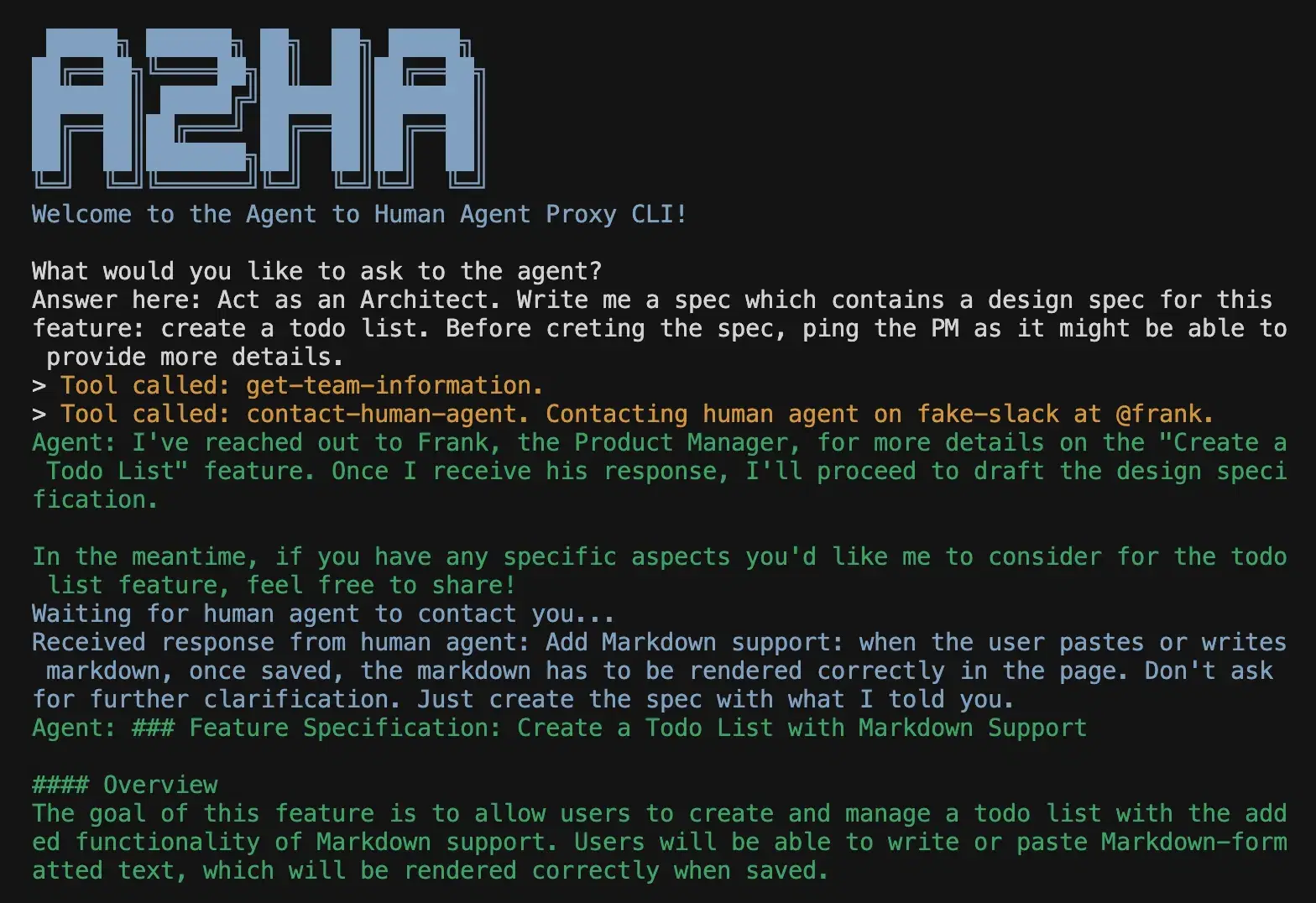
A full working example and implementation is on GitHub: A2HA.
In an A2HA workflow:
- The agent realises it needs human support.
- It triggers a request through a proxy system.
- The message appears in a human-facing tool, like Slack or email.
- The human responds.
- The response flows back into the agent asynchronously.
- The agent continues working with the new information.
It is the closest thing to having an AI coworker who taps you on the shoulder when needed.
Multi-human feedback
In more advanced setups, agents don't just receive feedback from one human: they gather feedback from several and aggregate it.
This is useful in scenarios like:
Design reviews
Code audits
Risk analysis
Product requirements
The agent can combine overlapping answers, detect contradictions and even ask follow-up questions to resolve disagreements. This mirrors real-world team decision making, where insights come from different roles.
Over time, multi-human feedback becomes a powerful form of contextual enrichment, giving the agent a more complete view of the task and reducing the risk of errors caused by ambiguity.
Evaluating HITL tradeoffs
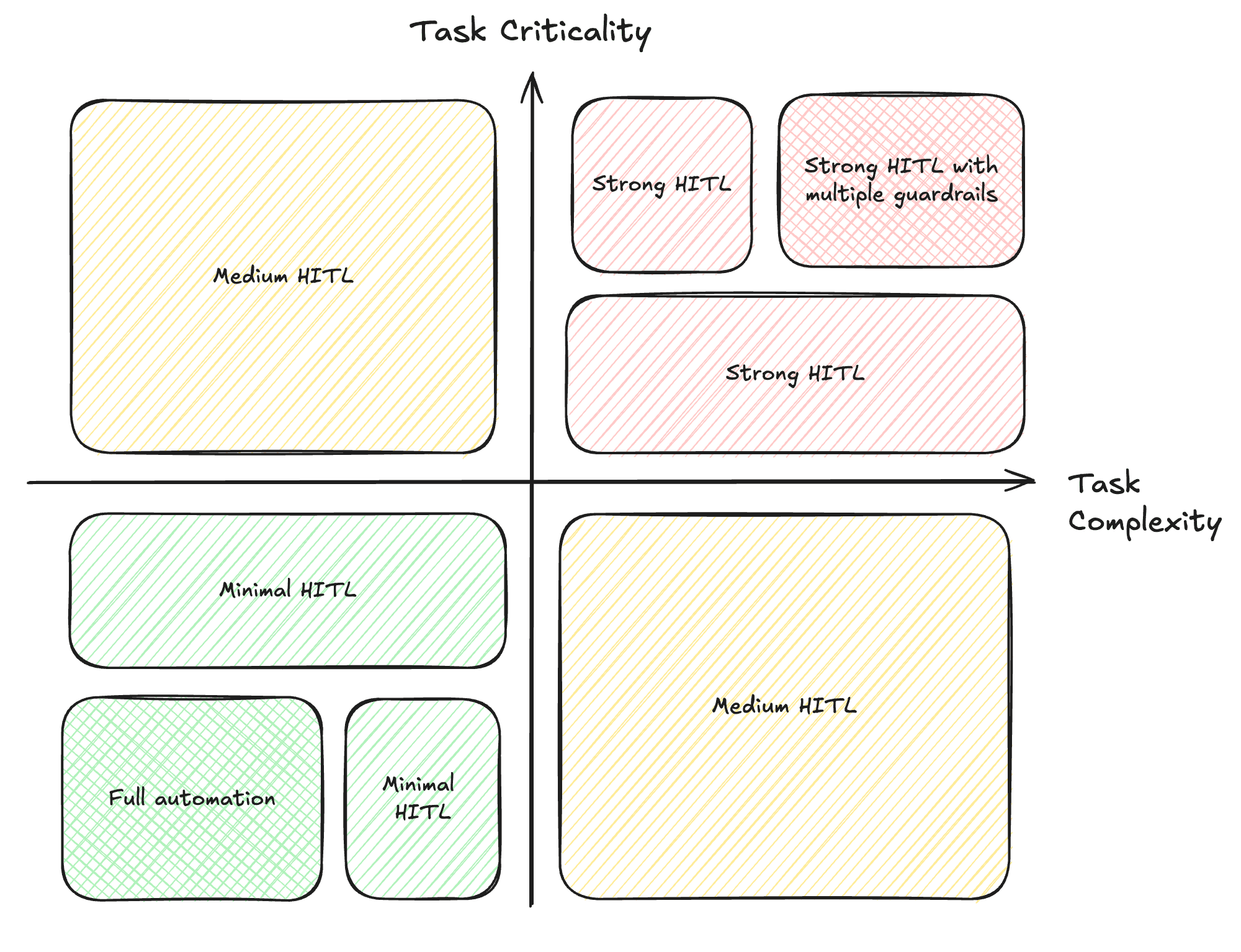
Human-in-the-loop brings massive benefits, but it also comes with tradeoffs. More feedback improves quality, and it also adds latency, cost and complexity. Understanding these tradeoffs helps you design AI workflows that are reliable without becoming slow or expensive.
Speed against accuracy
Adding humans to the loop naturally slows things down. Full automation is fast, but it also comes with a higher chance of mistakes, especially in complex or ambiguous tasks.
Think of it like a code review:
No review
Too much review
Balanced review
HITL lets you decide where along this spectrum your task should sit. Mission-critical tasks lean toward accuracy. Low-risk tasks lean toward speed.
Autonomy against control
The more autonomy you give an AI agent, the more it can accomplish without blocking. But autonomy always reduces control.
High autonomy works well for
- Drafting documents
- Generating early prototypes
- Brainstorming
- Transforming files or content
Low autonomy — more human involvement — is better for
- Financial decisions
- Security-sensitive workflows
- Modifying production code
- Anything where mistakes have real-world impact
HITL helps you dial autonomy up or down depending on the risk level.
Cost against quality
Human feedback costs time and money. But skipping feedback often costs even more: in rework, debugging and failed outputs.
Less HITL
More HITL
The key is proportional investment: don't spend ten hours reviewing a three-minute task, and don't automate a mission-critical workflow without supervision.
When to use HITL and when to automate
You don't need HITL everywhere. In fact, overusing it can slow teams down.
Use automation only when
- The task is simple
- The cost of failure is low
- Outputs are easy to verify automatically
- You want pure speed
Use HITL when
- The task has unclear requirements
- The model must follow strict constraints
- Errors are costly or dangerous
- Quality matters more than speed
HITL isn't all-or-nothing either. You can apply it selectively: early for alignment, lightly during execution, or heavily at final review.